Sunday, June 19, 2011

Reflections on the greatest gift of all -- from a daughter to her dad


(Originally published September 11, 1994)           


It's never to late to be thinking about Father's Day.

It's one of those Hallmark holidays that leaves a grown woman feeling pretty small. After all, what do you give a man who has more tacky ties (thanks to his kids) than Dolly Parton has colorless wigs?

Each holiday my sister and I look at each other with that "Got any bright ideas this year?" look, and then we resort to the usual tried but true alternatives to genius -- a box of Walnut pipe tobacco, or some peanut chews.

The notion that there's anything a kid could ever give a parent to even the score is unrealistic.The years of sacrifice and heartache that go into parenting are priceless -- not as in precious and adorable; as in costly, beyond measure.

Or so I thought.

I was flipping through this week's Time magazine when an article caught my eye. And I read with an unexplainable emotion the story of Chester Szuber, a retired Michigan Christmas tree farmer. In short, after 20 years of suffering with heart disease, living through three open-heart surgeries and enduring four years on on organ transplant waiting list, Szuber's new heart arrived on Aug. 18.

It wasn't technically his turn.

But a twist of fate brought his name to the top of the list. His 22-year-old daughter, Patti, had turned up in the University of Tennessee Medical Center, brain dead following a freak automobile accident during her vacation in the Smoky Mountains. Patti was a nursing student. She was the youngest of Chester's six children. She was a loving daughter who had probably given her dad a fair share of tacky ties and novelty gifts over the years. And she was a card-carrying organ donor.

I don't know about you, but I've never seen my pancreas. I'm not even sure if I could pick it out of a line-up on America's Most Wanted Internal Organs. I know that my kidneys look something like the beans in chili, and that my heart looks nothing like the shape of the Valentines I send every Feb. 14.

But unlike other human guts, the heart is symbolic. It is more sentimental to us than any other part of our anatomy. We regard it as much more than a squishy, pulpy mass with ventricles and arteries that get clogged from too much butter and bacon.

Our hearts rule us. They gauge our love. We are defined by our heart in degrees of feeling. Sometimes our hearts break. With any luck, they mend. And when it comes to big decisions, we either use our whole heart or half of it, in the follow through.

But these heart conditions are medically unrealistic. We know our hearts are basic biology. They pump blood through our bodies. If they stop, so do we.

I can only imagine what Chester Szuber thought about during the time it took for his daughter's heart to be transported the 600 miles from Tennessee to Michigan. What he said, according to the article, was: "It would be a joy to have Patti's heart."

The parent in me has trouble with Chester's joy. I have placed my hand over my 3-year-old Billy's chest, on demand, to feel his "heart beep." The rhythmic thump has always reminded me how fragile his life – all life – is. Little more than skin and bones seem to separate our physical life from certain death. I would sacrifice myself to preserve his tiny heart.

And yet, it is the daughter in me that was so moved by Chester Szuber's story. Death came to Patti Szuber too soon. She would never get to say good-bye. No more family Christmases in Michigan. No more well-intentioned Father's Day gifts.

But for every day Chester Szuber lives, he will rely on the steady pulsing of Patti's heart. He will never have to feel the permanent void felt by most parents at the loss of a child. The empty cavity in Szuber's chest, where the imperfect heart of a parent once beat, has been filled with the loving heart of his own child.

Chester Szuber's joy, as I try to comprehend it, is something too sentimental for science to explain. As a daughter, I've spent my whole life trying to give an adequate piece of my heart to my parents. But it never feels like enough.

And so it is for her final gift that a part of me envies Patti Szuber. More than the physical pumping of life-sustaining blood, Patti was able to give back to her father the precious gift of life he had first given her, 22 years ago.

I know in my heart, the real joy in that exchange between father and daughter belongs to Patti.


Postscript: June 19, 2011

I never spoke to Chester Szuber when I wrote the original column. It was harder 17 years ago to track someone down than it is today.

Over the years I have wondered about Mr. Szuber and his heart, so today I looked him up. It was easy. I dialed his number and got his answering machine, which included his cell phone number. So I dialed again, and Chet, as he prefers to be called, picked up on the third ring.

First, I wished him a happy Father's Day.

Then I had to ask him how he and his heart were faring all these years later.

"I feel like a million bucks. I pretty much woke up from surgery feeling great, and I have felt great every day since," he said.

I also asked him if it's true, what I've read, that sometimes a heart recipient finds that they take on some of the qualities of a donor.

"I don't know if it's from Patti's heart, but I have a lot more patience for people than I ever did, before getting her heart," he said.

He is back to Christmas tree farming, and still as grateful as ever for his daughter's ultimate gift.

"Bottom line is I'd much rather have this heart beating in Patti's chest, not mine. But she's taken good care of me over the years."

Tuesday, June 14, 2011

The Unrefined Art of Raw Food

             If you are what you eat, then eat something full of life, 
                  says raw foodie Mary-Ellen Hedrick, of Derry.
Eating in the raw: Mary-Ellen Hedrick has discovered the benefits of a raw food diet, and is ready to teach others. Here she whips up a batch of watermelon soup using fresh fruit, agave nectar
and cardamom, an aromatic spice.
By Carol Robidoux
DERRY -- It's encouraging to those in the local "raw food" trenches that First Lady Michelle Obama is talking about what Americans are putting on their dinner plates.
Last week the familiar USDA food pyramid was dismantled in an effort to adjust our bad eating habits. The push targets childhood obesity, but is meant to teach everyone some new ways of thinking about how we eat, and how what we eat affects our health.
On June 2 the First Lady introduced "My Plate," a straightforward approach to eating -- a dinner plate with four color-coded sections. Half is designated for fresh fruits and vegetables.
Mary-Ellen Hedrick, a dedicated raw foodie, would say that's about half right.
Hedrick truly believes that we are what we eat. Food that is eaten "raw," or without processing, additives or cooking beyond 112 degrees Fahrenheit, provides all the live nutrients a body needs to thrive.
Raw ingredients will become a no-cook 
marinara sauce in minutes.
"I realized sugary sweets were impacting me. I had no energy. I felt like I needed to take naps in the middle of the day," said Hedrick, who began seriously exploring the world of raw food about a year ago. "It's been a natural progression. In spite of myself, my palate has changed. And I can't argue with how I feel -- I have this mental clarity, and my energy is back."
What she's learned is that cooking food destroys enzymes which makes it harder for the body to digest. She says the process of digesting cooked food actually depletes our own enzymatic reserves, diminishing the natural energy and antioxidants in living food.
"And that depletion is what causes aging and disease," Hedrick said.
She is a middle school social studies teacher by day and now a certified raw food chef, by choice. Combining those two skill sets, Hedrick has launched a new business, Raw Kitchen, and is looking forward to spending her summer teaching others the benefits of raw food. 
During a recent cooking demonstration Hedrick whipped up a summer meal within minutes, using only fresh ingredients and a food processor, including watermelon soup, summer squash "linguine," macadamia nut and raw cashew Alfredo sauce, zucchini angel hair "pasta," and chilled marinara sauce, using tomatoes, sundried tomatoes, olive oil, dates, fresh parsley, garlic and cayenne pepper.
Raw food, as a movement, is growing, not only here, but across the globe, Hedrick said. With more attention being focused on what we eat, how our food is produced and the health risks associated with certain foods, she expects more people to explore the benefits of a raw food diet.
Which is not to say that she's a purist.
She has occasional lapses that may include pizza night or meat off the grill, especially when eating away from home. But Hedrick admits one deterrent has been the resulting "food hangovers," which leave her feeling sluggish and cloudy. She considers her current diet about 80 percent raw.
Zucchini angel hair "pasta" with marinara sauce.
"When you think about how much Americans rely on Fryolators and food that comes in boxes, you can really understand why eating raw can make you feel so much better," said Hedrick. "Sometimes I think about what was considered 'normal' eating when I was a kid -- a bologna sandwich on two pieces of Wonderbread covered in mayonnaise, and a glass of soda -- the thought of feeding that to my daughter, given how much more we know now about good nutrition, isn't an option," Hedrick said.
Despite its expanded raw food factor, reaction from hardcore food experts to the new USDA dinner plate quadrants have been mixed.
Vegan proponent Dr. Neal Barnard, who is president of the Physicians Committee for Responsible Medicine, remarked that with all due respect, isolating a quarter of the plate for protein is not necessary, since many whole grains and vegetables have sufficient amounts of protein.
Hedrick agrees.
She has found that raw nuts are no more expensive than meat, and way more versatile. She has learned to sprout wheat berries and lentils, which she uses to create a slew of recipes high in protein and enzymes.
When it comes to food prep, she relies heavily on her food processor, spiral slicer, and dehydrator. Her microwave is obsolete. Her oven, mostly in the way.
The greatest health benefit has been boundless energy,
said Mary-Ellen Hedrick, a raw food enthusiast.
"My next step toward 100 percent raw will be changing over from coffee to this," said Hedrick, reading off the ingredients from a bag of organic coffee substitute that included carob, barley, chicory, dates, almonds and figs.
"For me, the journey began because I have such a sweet tooth. I couldn't resist sugary desserts. But then I learned that there really are so many dessert options that are free of caloric impact, using nuts and fruits and agave nectar. From there, I just started to expand my raw food list," Hedrick said.
Her urge to change her eating habits coincided with the awareness that what she ate was affecting how she felt, for better or worse.
"Even before raw food, I was already becoming more aware of things like consumption of animals and animal byproducts. I was trying to opt for free range chicken and eggs, striving to be more considerate of the animals and buy those raised sustainably, rather than in cages," Hedrick said.
"At first, people who change over to a raw diet actually experience degrees of detox -- anything from rashes to nausea -- our bodies have accumulated so much stuff in the way of additives and chemicals. Once you get over that, you feel the difference, every day. Even starting off slow and eating raw for one or two meals, you feel a difference," Hedrick said.
"After that, your body tells you what it wants you to eat -- whether it's going to be a fruit kind of day, or maybe you are craving a handful of nuts. You let that drive you, and really start listening to your body, and there's no doubt you'll naturally start to change your eating habits," Hedrick said.
For more information or to schedule a cooking lesson contact Hedrick: mehedrick@live.com or  603-732-2425.

Twinkle, Twinkle, Little Star . . .


“It doesn’t matter who my father was;
it matters who I remember he was.” – Anne Sexton

Perception is everything.

For example, several years ago my sister and I planned to gather up some childhood memories and present them to our dad for a milestone birthday.
After a few days of mental gathering, we conferred.

I’d come up with a boatload of happy dad stories.

Meanwhile, Jean’s Titanic collection of moments had left her with a strange, sinking feeling.

"I remember one time I was sitting on Dad’s shoulders and he was singing ‘Twinkle, Twinkle,’ to me and I couldn’t stop crying,” my sister recalled.

"Why were you crying?” I asked.

"I was sad,” said Jean in a tone that implied I just wasn’t getting her.

"Why was it sad?” I pressed.

"I don’t really know. But every memory I came up with was depressing," my sister said. "I’m no good at this.”

How could this be? We breathed the exact same evergreen Glade-freshened air, ate the exact same sugar-frosted breakfast cereals and shared the very same wonderful dad.

But her memories were evidently skewed by her own unique internal sentimental, little-girl perception of things.

Perhaps “Twinkle, Twinkle” evoked in her little preschool brain a twinge of man’s constant puzzling over the enigmatic nature of space and supernovas.

Or perhaps she likened herself to a twinkling star, high above the world from atop her father’s shoulders, and feared that no one would ever really understand her.

No matter.

Because the point here is that my sister’s inability to think happy thoughts about our dad made me wonder what my own little kids were storing in their memory banks about their good old mom.

I decided to take a survey:

Me: Billy, what will you remember about me when you grow up?

Billy: How should I know? I’m just a little kid.

Me: I know that. But what will you tell your children about me someday?

Billy: Will you be dead?

Me: Not necessarily. I just mean how will you explain what kind of mother I was, you know; what kind of memories will you have?

Billy: (swallowing hard) Do you think you are gonna die before Dad? What will happen to me if you die before Dad? I don’t want you to die.

Me: Nevermind.

I smiled to myself and hugged my sentimental son, assuring him that I was going to live forever. Just then, Julianna came over, wondering what all the commotion was about.

Julianna: Why’s Billy crying?

Me: I asked him what will he remember about me when he’s all grown up.

Julianna: So why’s he crying?

Me: Because it made him think about me getting old and dead.

Julianna: Why don’t you ask me? I won’t cry about it.

Me: OK. What will you remember about me?

Julianna: Well, I’ll remember when you weren’t an old gramma and when you didn’t have gray hair and wrinkles and I’ll remember that you were funny and nice and soft, and how you always looked at me with love in your eyes. But will I have to push you around in a wheelchair?

Me: Only if you want to.

The moment was oddly reassuring.

You see, my kids have been breathing the same air, eating the same breakfast cereal and loving the same scatter-brained mom for their whole lives.
Despite their different reactions I know they will end up on the same page, just like my sister and me.

Because, concrete memories aside, when Jean and I look at our dad we see a tall, dark-haired, dependable, funny man, able to leap tall buildings in a single bound; a man of much integrity and few words.

We see a man who can sing “Twinkle, Twinkle” with enough feeling to make a little girl cry.

And even though that little girl may not know it at the time, eventually she’ll figure out that what made her so sad was the accompanying thought, that one day she might grow up to be too big to sit on his strong shoulders, or to simply get lost in the sweet sound of her daddy’s song.

Roving Reporter: Email scams, friendship and computer insecurities


Roving Reporter Carol Robidoux
Maybe this has happened to you: You sit down with a cup of coffee, open your e-mail and scan the in box for something worth reading when you see “HELP NEEDED” with no fewer than 10 exclamation points, sent from someone you actually know.
You gulp your coffee as you click open the email, further concerned to learn that your “friend” is writing with tears in her eyes, having been mugged in a hotel park during her brief vacation to the UK. Bad guys took all her money and credit cards and now, to catch her return flight which leaves in a few hours, she needs money to settle her hotel bill. No one at the embassy or foreign police department is being particularly helpful.
She will take any help – as in money – you can wire. She'll pay you back when she returns.
She signs her name. It feels like a genuine cyber SOS. So what do you do?
That all depends on how familiar you are with the increasing sophistication of e-mail scams infiltrating our personal email and social networking accounts. I know this because last Wednesday my personal email account was hijacked and several hundred people, ranging from relatives and friends to law enforcement officials and Derry town employees, received a virtual shake down from an invisible bad guy pretending to be me.
Screenshot of an Amazon scam.
In the week that followed, I learned a lot about the nature of people, the fragility of email security, the boundaries of friendship, and the network of cyber crime stoppers working to prevent the good-hearted yet somewhat gullible masses from falling prey to such scams.
Like the group of Derry town employees waiting for me on the third floor of the town hall, just hours after my email account went AWOL, most of them relieved to see I wasn't going to miss the appointment after all.
“We took up a collection for you,” said Town Administrator Gary Stenhouse, jingling the change in his pocket. Hey, it was better than nothing, I figured, given the normally hostile reception reporters get from municipal employees they scrutinize in print.
I also heard someone from the newspaper alerted the editors of my faux plight. I later found my bosses were unanimously put off that I failed to file stories in advance of my UK vacation for the next day's paper. Even Union Leader Publisher Joe McQuaid took the time to let me know that he'd gotten two internal emails and an anonymous phone call from people wanting to help me.
He said he was personally still weighing the pros and cons of donating to the “Save Robidoux” fund.
After recouping what remained of my virtual identity – and dignity – I lapsed into reporter mode and learned that this particular scam continues to swindle people across America of their cash – so far hundreds of thousands of dollars have been wired to a nameless, faceless bad guy an ocean away in the name of friendship. It's so prevalent the FBI has added “The Stranded Traveler Scam” to the Internet Crime Complaint Center's alert log.
Jeannette Toscano of IC3 explained they are sort of cyber hero justice league, a partnership between the FBI, the National White Collar Crime Center (NW3C) and the Bureau of Justice Assistance, all committed to fielding complaints from scam victims and shutting down the cyber villians.
“Once you opened that email, there could have been a worm in the background that allowed the scammer to get access to your contacts, which is how they perpetuate the scam,” said Toscano.
Most likely to respond are the kind-hearted friend or particularly vulnerable grandmothers and marginally computer-savvy relatives. You know them as those who regularly forward notoriously annoying emails detailing political injustice or medical calamities or warm fuzzy animal photos that can be stopped, aided or enjoyed just by resending an email to every “strong woman,” “equally fed-up American,” or “someone in need of a smile” you know.
Still a little shaken from the feeling of vulnerability, I wanted answers. I called academic cybersleuth Gary Warner, a University of Alabama at Birmingham professor whose virtual street cred includes being a card carrying member of the FBI’s Digital PhishNet and Team Leader of the Phishing Incident Reporting and Termination Squad.
I asked The Terminator how this happened to me, one who regularly refers others to Snopes.com to debunk email spoofs and never falls for promises of money from Nigerian diplomats.
He seemed to want to blame the victim, who in most cases have inadvertently given up password information through ignorance. He was puzzled to learn I use Gmail, since just about all of the 1.5 million daily spam emails he mines with his spam-catching software originate with Yahoo or Hotmail accounts.
Then he asked me if I'd received an Evite lately – that's a popular online invitation site that has pretty much eradicated the need for paper party invitations and postage stamps.
I had. But told him I hadn't had time to respond. I'd been too busy fielding responses to my spam email and changing all my account passwords to think about developing a social life.
“Just last week Evite spam was responsible for a huge amount of malware – 11,000 copies came into my spam collector alone,” Warner said. He went on to inquire whether I'd opened anything from Target or Amazon lately – two more unexpected sources that, just last week, delivered unwanted malicious software to unsuspecting computer users everywhere.
He sent me a screen shot of the Amazon scam. It didn't look familiar to me, but it also didn't look suspicious.
“The Amazon scam says something like 'thank you for verifying your new email address. Please verify it belongs to you.' Then it directs you to click a little button in the center, and if you click to start the verification process, it steals your password,” Warner said.
He wanted me to remind readers that protecting your email password is probably the single most important safeguard to preserving the integrity of your virtual identity.
“People tend to not think about their email password being important, yet the most common password people choose for their email account is still 'password.' Think of what the bad guys could do with your email password. How do you reset your bank password? By requesting help, which comes to your email, including a link back to your bank site, where the bad guy, who now controls your email, can easily reset the password,” said Warner.
“If a criminal has your email account, he can access your bank accounts, your credit card accounts,, any site you shop from, like Amazon or Best Buy. All those accounts are set up with the same singular point of failure. If I have your email password, I can reset every password in your life,” Warner said.
Masking the paranoia I was now feeling over my computer insecurities, I asked Warner if paranoia is a plausible response to the real risk here. I was thinking about the ease with which so many of us use our email and Internet accounts for work correspondences, document sharing, online banking and Christmas shopping.
“People ask me that all the time. As much as I know about online crime, do I still use online baking? Of course I do. Honestly, we are still far more likely to have an account stolen by the waiter who takes our credit card into another room at the end of a meal than by some unseen, online predator,” Warner said.
Needless to say, I've learned some valuable lessons in all of this. For one, that all my hard work building journalistic bridges in the town of Derry are enough to see me safely home, should I ever find myself stranded abroad and in need of airfare. Also, that email scams happen, and everyone can be a victim.
And most of all, I've learned that the next time someone delivers a meal tab to my table, I will be the one paying with cash
.

Thursday, June 9, 2011

The power of a wilted 4-leaf clover through 16 years of marriage


What do you figure the odds are of finding a four-leaf clover without even looking?

I know -- but I'm not telling, just yet.

But I will tell you it's been more than 20 years since I plucked one from the yard at my mother's house.

And wouldn't you know, there was one sitting on my washing machine in the kitchen this morning -- just in time to remind me how lucky I was to have been in Mr. Nelson's ninth-grade honors English class at Woodrow Wilson High School back in 1974.

We were in the midst of a fascinating rotation which included Greek mythology, Shakespeare, Hemingway and public speaking. And we were just getting our final pep talk on how to speak effectively to a bunch of ninth graders (talk fast and use a visual aid), when I noticed the kid sitting next to me looked a little green about the whole prospect.
"Whassamatter?" I asked him.

"Nervous, I guess," said the quiet kid who lived down the street, whom I had known casually since seventh grade.

Since it was my nature to be helpful, I had a brainstorm. I reached into my 14-year-old bag of tricks. It took a minute of sifting through some other good stuff -- notes passed to me by my friend Irene in science class, pencil stubs with big rubber erasers, loose lunch change and a broken cigarette -- but I found it.

It seemed as if I had pulled a stubborn sword from an ancient stone.
"Here. Maybe this will help," I said, offering a little green clover encased in Saran Wrap to my jittery friend.

"What's this?" he asked, perhaps thinking I was peddling some unrefined drug.

"It's a four-leaf clover. I found it the other day in my back yard -- without even looking. You can keep it. Really."

And my token was just in time.

"Jimmy Robidoux -- you're up," Mr. Nelson bellowed in his best baseball umpire voice.

And thanks to the lucky charm, Jim hit a homerun that day.
"I got an A," he mouthed the words to me, once his heart had found a normal pace again, following his dynamic speech on biblical truth and the end of the world.

Later that day, he even had the courage to stop by my house and thank me again, this time with sound.

"I thought I'd better return this -- in case you needed it for your speech tomorrow," he said politely.

I shrugged it off and told him to keep the clover. I guess I had more than enough confidence in my knowledge of surrealist painter Salvador Dali, my topic of choice.

And besides, I had a really cool visual aid prepared -- a decent reproduction of Dali's "Melting Clocks" -- just in case I didn't fascinate my peers for three minutes with the content of my research.

And I would have invited Jim in for a Fresca, at that point.

But he said he'd better get back to his girlfriend, Jennifer, who was busy digging her toes into the gravel at the bottom of my driveway.

Anyway, it only took us about three more years and a few failed attempts at finding true, teenage love with other partners until we were able to fully comprehend the power of a wilted weed.

Five years later we were married.

And this Friday will be our 16th wedding anniversary.

So when I saw the familiar little rectangle of Saran Wrap surrounding a green, four-leaf clover on top of my washing machine, naturally, I had to ask my husband, "Where'd this come from?"

"Oh, yeah, I forgot to tell you. Aimee's friend, Kira, found a bunch of them. She said she was getting out of Aimee's car right in front of the house and she saw one -- a whole bunch of them, in fact. I wrapped one up for you. I have one in my wallet, too," said my husband, marveling, "What do you figure the odds are of finding a four-leaf clover, let alone a whole bunch of them, just like that, without even looking?"

I suppose it was a rhetorical question.

But as I said, I suddenly know the answer.

The chances of finding a four-leaf clover, just like that, without even looking, are probably once in a lifetime.

Unless God decides to send a simple anniversary present to a couple of impulsive teenagers who survived ninth-grade English class and went on to find each other eventually, against all odds, like a tiny miracle in a field of clover.

Originally Published June 5, 1995
Bucks County Courier Times

Sunday, May 29, 2011

See the Boy, Know the Man


More than a decade ago I saw a television show on PBS, a documentary about a group of kids from England who were studied over several decades at seven-year intervals. It was called something like, "From 7 to 21 Up."

For a woman who has trouble recalling her natural hair color, it seems strange that a TV show would stick with me for so long.
But this show hit me like a shot of permanent dye with a peroxide chaser.
The premise of the show was that the boy (or girl) at age 7 reflects the man (or woman) he (or she) will one day grow to be.
Sure enough, in most if not all cases highlighted, that’s what happened to the little Brits.

If a boy was unstable, unmotivated, lazy, aimless or indifferent at 7, he was still struggling with life at 14, 21, 28 and 35.
If he was focused, efficient, confident, inquisitive and hopeful at 7, he was on track at 14, 21, 28 and 35.
Sure, it was just another theory of early childhood development, like the critical “wonder years” theory, or birth-to-5 pre-conscious memory type stuff.
But in hearing the boys’ world view at 7, then again at 14, and so on, it became clear to me that there might actually be something to this hypothesis.
Of course, I know there are many things that can happen to a boy from 7 to manhood that will affect his outcome, one way or another. But the show satisfied some questions about nature and nurture. Both matter, but without nurture, nature has no safety net.
What prompted me to think about all this was my younger son’s 8th birthday, which was Sept. 30.
From birth, Billy has been a catalyst in many ways. He brought me back to primal motherhood after nearly 11 years of evolving with my former baby, Neil, and the baby before him, Aimee.
Billy has always challenged me to look at the world from his point of view.
But that’s not all.
He then insists on answers, explanations, conclusions, balance and morals to every story.
Not unusual demands from a little kid, perhaps.
But what other boys might only think about or barely ponder, Billy would explore in full spelunking gear.
Sadly, it’s a trait that’s suddenly waning. Perhaps that’s why 7 is a pivotal age. Maybe it’s the beginning and ending of something irreplaceable in our development.
Anyway, in all his inquisitive glory days, Billy often reminded me of the boy Neil used to be.
Of course, Neil has nearly tripled in age since 7 and certainly qualifies for manhood by most standards.
Still, he’s a work in progress.
Over time I’ve witnessed his emotions ebb and flow, sometimes lost in tidal waves of frustration.
Other times, his childlike enthusiasm takes me over like the chicken pox.
But at 19, I sense Neil’s returning to the boy I knew at 7, the one who shared his dreams with me, always, in fine detail; the boy who sensed he was destined for something big.
The boy who held my hand in public long after it was a matter of his safety, and vowed he’d never grow too big or too cool to be my baby.
If the boy-to-manhood experiment meant anything at all, perhaps it’s that the future is not so random as we might think and that, for everything we’re fortunate to gain in life, there are other things ingrained from birth.
Which means to me that we should be conscious of how our sons are growing up, paying attention to how we respond, or don’t, along the way.
And if at 7, the boy we see before us is the least bit unstable or indifferent or unsettled, then we should know which way to push.
See the boy at 7 and know the man – that was the message of the documentary, as I recall. In some cases, it was encouraging to see how each little boy grew. In others, it was disturbing, even painful, to see the boy at 7 and know – before the camera started rolling – the direction his life was going to go by the next installment of his life.
I’ll never know, for sure, if that documentary affected the way I’ve raised my sons. But at this point, I’m encouraged.
I see the boy Bill is at 8 and somehow know the man who will be honest, compromising, meticulous, confident and loving.
And the boy in Neil I knew at 7 as wise beyond his years is the man I see now at 19 – hopeful, adventurous, determined, sincere and still growing.

Originally Published: 
Oct. 3, 1999 
Bucks County Courier Times
Levittown, PA

Saturday, May 21, 2011

Considering Romance, Parenting and a Fruit Fly with 14 Eyes

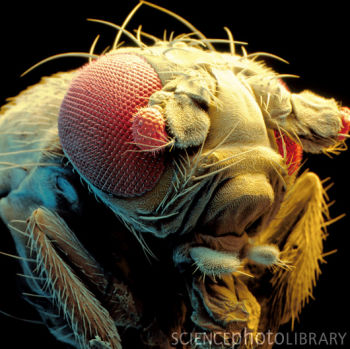
This mutant fruit fly has two small ectopic eyes in the place of antennae, seen here between 
the large red compound eyes. PHOTO CREDIT: EYE OF SCIENCE LIBRARY.
I remember reading a short but interesting science article in a 1995 Time Magazine. This kind of mutant-breeding information was right up the alley of my older son, Neil, who back then was 15 and a dedicated X-Men comic book collector and connoisseur of news stories about oddities of nature.  So I figured the article might present a great opportunity for a quality mother/son conversation:
ME: "Did you see there was a neat article in ... "
NEIL: "I read it."
He was, as usual, short on words and way ahead of me.
The article, "Jeepers! Creepy Peepers!" appeared in the April 3, 1995 issue of Time and described the latest scientific adventures of researches from the University of Basel in Switzerland.
In a "serious effort to understand how nature fashions something as magnificent as an eye," these scientists created a swarm of fruit flies that had multiple eyes -- not just on their heads. These gnats sprouted eyes on their legs, antennae, wings -- the article says some of these test-tube flies had as many as 14 eyes.
Fourteen eyes! I find that as repulsive as it is intriguing,
I guess it could be that Neil inherited his interest in science from me. After all, I've always been one to linger just a little too long at circus sideshows featuring bearded women and dog-faced boys.
Anyway, I was just wondering what Neil thought of the whole thing. So I asked.
ME: "So, Neil. What did you think?"
NEIL: "I don't really get it. What's the point?"
Well of COURSE Neil didn't get it. He hadn't lived LONG enough to get it. But this mother of four and student of life saw the possibilities, even then. I understand the value of a mom genetically predisposed to actually having eyes in the back of her head, which is how I know those Alpine developmental biologists are standing in some mighty deep and fertile pay dirt.
First, of course, it helps if you understand the origin of this scientific breakthrough.
As the article explained, it seems there is a gene known as eyeless. Fruit flies lacking this gene don't develop eyes. That's why the gene is called eyeless. (And you thought science was so technical.) So they take these eyeless genes, insert them into teeny tiny fruit fly embryos and  -- poof! It's a family of bugs with more eyes than Mississippi.
The thing is, the experiment worked just as well when they tried it with an eye-related gene from a mouse instead of the eyeless fruit fly gene. The result was the same: Fruit flies with multiple eyes.
This is amazing news for all of us.
For scientists, it suggest that mouse genes and fly genes are so similar that they must share a common ancestor -- a "sea-dwelling worm that lived 500 million years ago."
To molecular biologists, it means we are all basically just big flies.
And while I'm not certain how you go from mice and fruit flies to prehistoric worms, I do see the mammal /worm connection. It's believable, even from a layperson's point of view.
After all, haven't we all met our share of people we could accurately refer to as sea-dwelling worms?
But what makes this even more amazing news is that, with just a little imagination, science can use this "eyeless" research to benefit the entire human race.
For example, you know that guy who cut you off in traffic yesterday? The one you called "brainless?" It's not what you really called him, but it's what you meant. Scientists could simply isolate his brainless gene and -- poof! Before you know it, a new and improved breed of driver is born with built-in common road courtesy AND the ability to parallel park.
Or that person you just phoned for assistance at your favorite utility company? The one who was rude? The one who kept you on hold for five minutes only to disconnect you? One successful Swiss-scientist procedure on her tactless gene and you are practically guaranteed a Utopian world where people who answer business phones are never rude.
But it doesn't stop there, folks.
Suppose your kids won't help around the house. Get some professional gene splicers to isolate their choreless gene and before you know it, a generation of children is born instinctively beating each other with brooms for first dibs on household chores.
You say your husband hasn't sent you flowers or surprised you with reservations at a nice restaurant since -- well, he's just never done it? It's not really his fault. It's that damned romanceless gene. Send him off to the University of Basel so they can reconfigure his DNA.
Oh sure -- it will take a generation or two for romantic husbands to flourish. But it's worth the wait.
And think of it this way: While you're doing your part to create perfect husbands for your children's children, imagine, just for fun, how it would feel to have the following conversation at a party:
PARTY GUEST: "Where's your husband these days? I haven't seen him around."

YOU: "Him? Oh, he was a real nice guy, but he wasn't genetically predisposed to romance. So I donated him to science.